AI is changing the way companies go to market. That’s hardly news at this point. What’s becoming increasingly clear, however, is that the companies investing the most in AI aren’t necessarily the ones getting the most out of it.
The technology is advancing at an extraordinary pace, but most organizations are still figuring out how to put it to work. And while AI dominated much of the conversation at Pavilion’s GTM2026 in New York, the bigger discussion was about something far more fundamental: how do we turn innovation into actual revenue growth?
Our team at Mindmatrix spent September 28 through October 1 at The Glasshouse in New York City meeting with revenue leaders, attending sessions, and running live demos of our new Go To Market Operating System (GTMOS). Josh Ruffner, Josh Hutchison, Paul Bruce, and I had some terrific conversations about where the industry is headed and what needs to change to get there.
I also had the opportunity to lead a roundtable on how AI is reshaping partnerships and their role in the modern GTM organization. One thing became clear throughout the week: partnerships are increasingly important to revenue growth, but they’re still too often treated as a separate function rather than an integrated part of the GTM strategy.
Four themes stood out to our team:
- Adoption matters more than innovation. Having the best technology means very little if nobody uses it.
- People follow people. Technology adoption is driven as much by peer influence and demonstrated success as it is by product capabilities.
- Alignment beats activity. More tools, more campaigns, and more activity don’t automatically produce more revenue. Connecting the teams responsible for growth does.
- Avoiding friction has a cost. Whether negotiating a deal or driving organizational change, the comfortable path isn’t always the right one.
These aren’t necessarily new challenges. But AI is forcing us to address them much faster than we have in the past.
Here are our key takeaways from the week.
1. Why Adoption Matters More Than Innovation
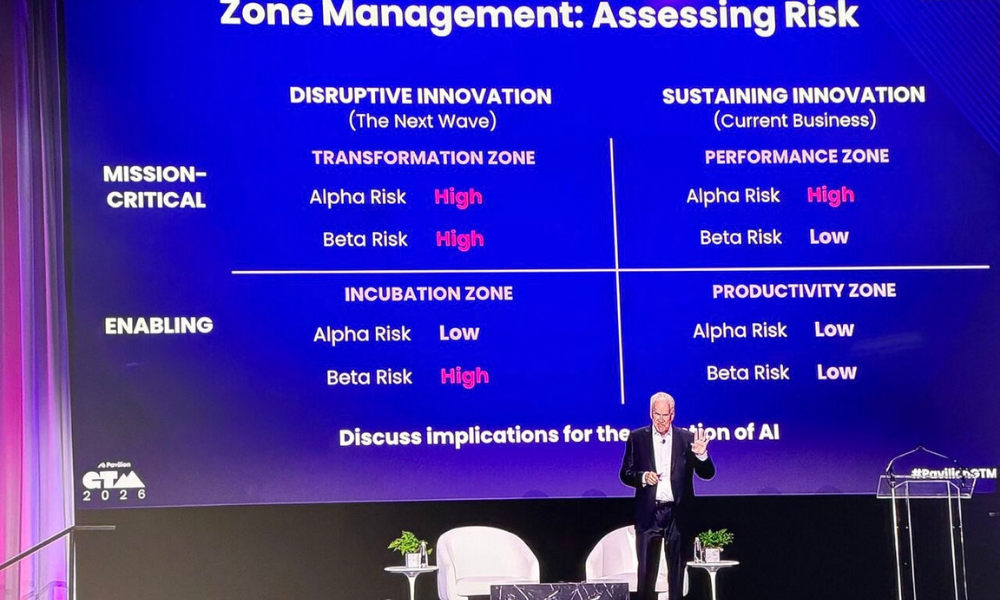
The session our team was still talking about on the way home was a conversation between Geoffrey Moore, author of Crossing the Chasm, and Sam Jacobs, CEO of Pavilion. It was one of the best conversations I’ve heard all year.
Moore’s argument was simple. “The speed of innovation is off the charts,” he said. “But the speed of adoption has not changed. Which means adoption is the gating item, not innovation.”
Two details sharpen the point.
- Agentic AI has arrived, but adoption hasn’t kept pace. Many organizations have a pilot or a single use case running, and far fewer have made it part of how work gets done across teams.
- And money is no longer the obstacle. For companies at the forefront of innovation, Moore pointed out, prospects increasingly have budget set aside for what is being sold before the sales conversation even begins. He called that an important metric, and it was the talking point that stuck with me most.
So the demand exists and the budget is allocated. What is often missing is an owner. In many companies, adoption sits somewhere between product, customer success, enablement, and sales, which tends to mean nobody is fully accountable for it. For CROs and GTM leaders, the question is simple: Are we spending enough time solving for adoption?
The competitive advantage in AI won’t necessarily belong to the companies with the most sophisticated technology. It will belong to those that successfully integrate it into how their teams work, make decisions, and generate revenue.

2. How Peer Influence Accelerates AI Adoption
Moore also explained why adoption is slow, and his answer had little to do with technology. “The reason it’s not adopted yet is very simple,” he said. “People adopt technology when they see their peers doing it and not before.”
That has a practical consequence for go-to-market teams. Product capability alone doesn’t close the adoption gap. Visible proof from people in the same role does. Reference stories, usage data, and partner success stop being simply marketing assets and become part of the adoption strategy itself, both inside a customer’s organization and across the broader market.
A data point from the Women of Pavilion sessions early in the week added to this discussion. I attended as much of that programming as I could, and heard a speaker share research suggesting women are more likely to use AI than men. That surprised me.
Set next to Moore’s point, it raises an interesting question. If people adopt technology when they see colleagues succeeding with it, shouldn’t we be paying more attention to who’s already using AI well inside our own organizations?
Those people are our internal proof points. They’re the ones who can demonstrate what’s working and help others adopt it.
Find the people getting results. Understand what they’re doing differently. Then make their success visible to everyone else.
We spend an enormous amount of time thinking about how to sell technology. Perhaps we should spend a little more time thinking about how people actually adopt it.
3. Why Revenue Orchestration Requires GTM Alignment
Josh Hutchison summed up what he kept hearing across the event on its final day: growth isn’t coming from doing more of the same. It’s coming from better alignment between sales, marketing, customer success and partnerships, and from making every motion work together instead of in silos.
This connects directly to adoption. An AI tool adopted by one team inside a disconnected go-to-market organization improves that team. But the handoffs remain slow, data stays fragmented across systems, and partners are often the last to benefit. The case for working as one coordinated revenue organization came up all week. What received less attention was how that actually works when each team runs on its own tools, processes, and version of the data.
Alignment requires more than good intentions. It requires shared infrastructure and coordinated execution.
That’s where revenue orchestration becomes important.
Revenue orchestration connects the teams, data, workflows, and technology responsible for generating and retaining revenue. Rather than treating each GTM function as a separate operation, it creates a coordinated approach to how the organization works.
A Go To Market Operating System (GTMOS) brings that approach together across four core functions: sales, marketing, customer success, and partnerships, with Revenue Operations (RevOps) providing the underlying data, governance, and operational structure.
And that fourth function matters.
Most conversations about revenue orchestration focus on sales and marketing, sometimes extending into customer success. But partnerships contribute significantly to revenue in many organizations, and they’re too often missing from the conversation.
A complete GTM strategy needs to account for all four.
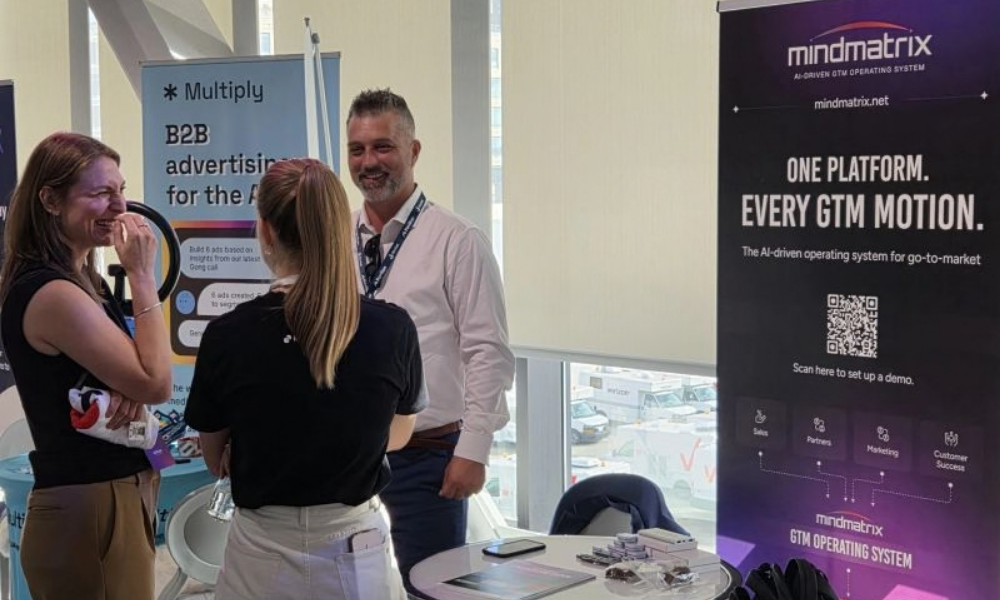
That was a significant part of the conversation at the Mindmatrix booth.
Our team walked attendees through how Mindmatrix GTMOS is designed to bring sales, marketing, customer success, and partner management into one coordinated operating environment, without requiring companies to replace their existing CRM and other core systems.
We also gave attendees an early look at the new Mindmatrix.ai Co-Pilot capabilities launching this fall.
Josh, Josh and Paul carried the bigger-picture version of that conversation beyond the booth, discussing where Mindmatrix goes next and how AI-powered revenue orchestration can change the way organizations manage growth.
More activity isn’t the answer. Better orchestration is.
4. Why Avoiding Friction Costs You
The most personal takeaway came from a Women of Pavilion session on negotiation, and it was blunt: “If there was no negotiation, you probably undershot.”
The speaker framed every negotiation around context, identity, and choice, which translate into three questions.
- Context: What should I make, or what should I charge?
- Identity: Why me, or why us?
- Choice: And why anyone at all?
The line that landed hardest was that people avoid friction, and avoiding friction leads to less.
I recognized myself in that observation, and I suspect many revenue leaders would also. It applies to pricing conversations, renewal terms, and partner agreements, where the comfortable deal isn’t always the best outcome. It also applies to leadership and organizational change.
How often do we avoid difficult conversations about outdated processes, disconnected teams, or technology investments that aren’t delivering the expected results?
Changing how people work creates friction. It requires challenging established processes, redefining responsibilities, and sometimes asking teams to abandon approaches they’ve relied on for years.
That’s especially true with AI adoption.
Buying technology is relatively easy. Getting people to change their behavior is considerably harder.
And that brings us right back to Moore’s central point.
The leaders willing to address that friction are the ones most likely to turn AI investments into measurable business results.
Sometimes the cost of avoiding change is far greater than the discomfort of making it.
Innovation Gets the Headlines. Adoption Gets the Revenue.
That was my summary of the week, and it captures the challenge facing revenue leaders.
Successful AI adoption means moving beyond individual tools and isolated experiments to make AI part of everyday revenue operations. For GTM organizations, that requires connecting sales, marketing, customer success, and partnerships through shared data, coordinated workflows, and measurable outcomes.
The objective isn’t simply to automate more tasks. It’s to improve how revenue teams work together, reduce operational friction, and accelerate growth.
That’s also the thinking behind what we’re building at Mindmatrix.
Our AI-powered Go-to-Market Operating System brings together the four pillars of modern GTM: sales, partnerships, marketing, and customer success. Rather than treating each as a separate operation, we’re building a coordinated environment where teams can share information, orchestrate activity, and use AI to eliminate unnecessary work. We call it GTMOS.
Importantly, partnerships are part of that operating model from the beginning, not an afterthought.
Because the goal isn’t to give everyone more technology.
It’s to help organizations generate more revenue from the technology, people, and partnerships they already have.
Our team is grateful to Pavilion for an excellent event, and to everyone who stopped by the booth, joined the roundtable, or pulled one of us aside in the hallway. If we did not get the chance to connect in New York, let’s keep the conversation going.