
Every partner program leader in the room at Catalyst 2026 heard some version of the same warning: if AI isn’t already pervasive across your organization, evolved beyond pilot projects, and is operationally disciplined, you’re behind. The question worth asking is whether that feeling is legitimate, or whether it’s just conference-hall pressure. Mindmatrix was in New York to find out, and came back with a clearer picture of where partner ecosystems actually stand on AI, and where the industry still has real work to do on what will be the fundamentals.
Mindmatrix was on the ground for both days, with Vaughn Mordecai, Paul Bruce, Josh Hutchison, and Eric Weber connecting with partner leaders, clients, and technology partners across a packed lineup of keynotes, roundtables, and hallway conversations. The room included familiar names in the partner ecosystem space: AWS, IBM, and Oracle, some new ones like Anthropic, and OpenAI, Mindmatrix clients like Acumatica, AvidXchange and Vasion, and partners such as Bodine Group and AscendXdigital, among many others. What follows is a recap of the themes that mattered most to Mindmatrix, along with the questions Catalyst raised that the industry hasn’t fully answered yet.
AI Is Front and Center, But Adoption Is Uneven
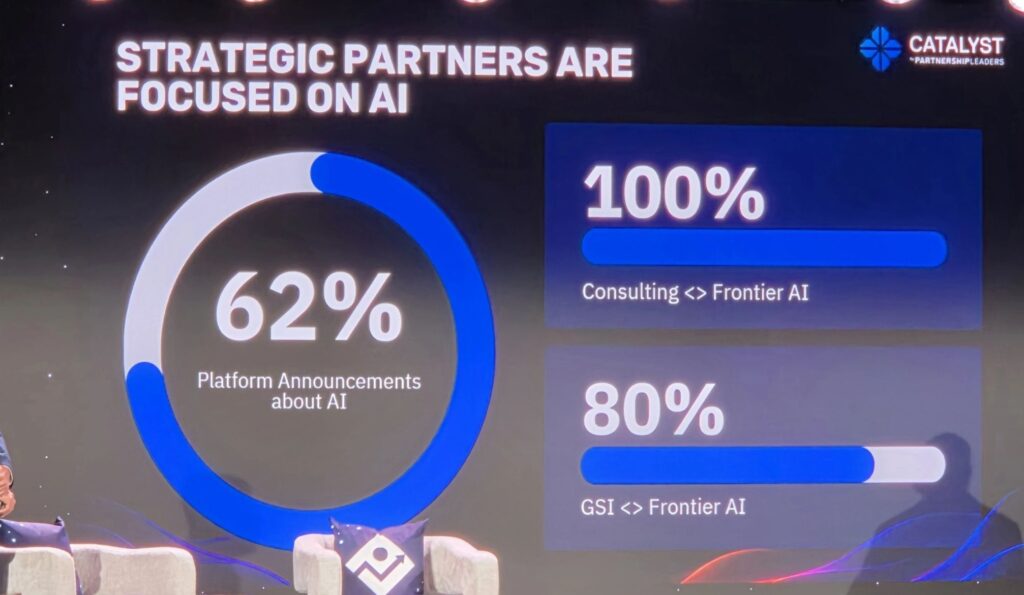
Partnership Leaders used the event to launch a connector linking its own research to frontier AI models, including Anthropic, OpenAI, Google Gemini, and Microsoft Copilot. The goal is to give partner program leaders faster access to frameworks and best practices, pulling directly from the research Partnership Leaders has already compiled. It’s a strong signal of where the industry is heading: AI isn’t a side conversation at partner events anymore, it’s infrastructure.
That shift is showing up inside partner programs too, not just around them. Digital workers are appearing in more channel organizations, in the form of AI-powered CAMs and PAMs (channel and partner account managers) that handle deal registration, coaching, technical Q&A, and next-best-action recommendations. These are the repetitive tasks that used to consume a manager’s week, now increasingly handled by AI. And, they’re managing the long-tail partners.
Here’s the catch: some programs have this live today. Most don’t. That gap raises a genuinely useful question for any partner organization evaluating its own roadmap: if you were building an AI-powered digital PAM from scratch, what would you actually want it to do? Where should its capabilities start and stop, and what absolutely has to be included versus what’s just a nice-to-have? Catalyst didn’t offer a single consensus answer, and that’s arguably the more honest takeaway. The industry is still figuring this out in real time.
Three Perspectives on Where Partnerships Are Headed
Day one wrapped with plenty to think about, but day two’s keynote lineup delivered some of the sharpest insights of the event.
The Economics of AI Adoption
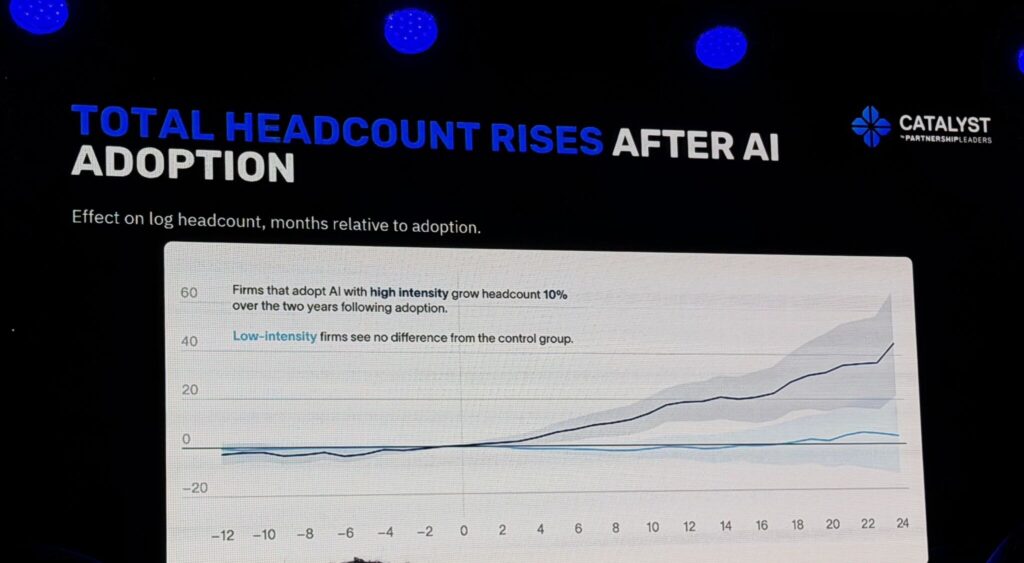
Ara Kharazian, chief economist at Ramp, opened day two with research findings that ran counter to a lot of assumptions in the room:
- Companies adopting AI were more likely to hire, not less. Whether that trend holds in the long term is an open question, but in the near term, AI adoption and headcount growth appear to be moving together, not in opposite directions.
- Unlike traditional software, AI doesn’t create vendor lock-in. The most advanced AI adopters are running multiple AI vendors simultaneously rather than standardizing on one.
- Open source and Chinese-built AI models haven’t gained meaningful traction among the companies Ramp studied. Organizations are still concentrating around Anthropic and OpenAI. Cost isn’t the deciding factor here. Technologists simply aren’t confident yet about the long-term implications of building critical infrastructure on those alternatives, and most aren’t willing to bet their jobs on it.
Data First, Differentiation Second
Dion Smith of Siemens offered a different angle, grounded in the realities of running partnerships inside a large, established organization. His core points:
- Get a real handle on your data before you try to differentiate. Most partner organizations discover they’re less unique than they assumed, and that clarity is what actually reveals where the real differences are worth focusing on.
- Market opportunities don’t come around constantly. When they do show up, the organizations that benefit are the ones already positioned to move on them.
- Siemens’ partnerships org structure looks a lot like most others in the industry. Smith’s framing was that OT and IT converge faster than most people expect once partnerships get involved. His practical advice: automate what can be automated, and invest time in understanding the specific language of each partnership type. GSI managers should speak GSI. Disti managers should speak Disti. Vertical leaders need to know their vertical. It’s not a nice-to-have, it’s purposeful and it shows up in how partners engage.
Outcomes Over Technology
Leah Yomtovian from Oracle closed the keynote block, and her presence mattered in a specific way: enterprise technology partnership teams are increasingly showing up at events like this, a shift that hasn’t always been the case. Her perspective:
- As products transform, GTM strategy has to transform with them, and so does the partner ecosystem responsible for bringing those products to market.
- Partners that will thrive in this environment need to double down on outcomes, not technology. In healthcare, banking, CPG, and similar industries, customers don’t care about the tech itself. They care about what they’re trying to accomplish with it. Partners need to operate as trusted advisors focused on outcomes, not just implementation.
- Time to value is becoming the real competitive battleground. Traditional partner companies are now competing directly with AI-native partners, and the only way to keep pace is to match the speed at which AI-native companies deliver value.
What Came Out of the Roundtable Discussions
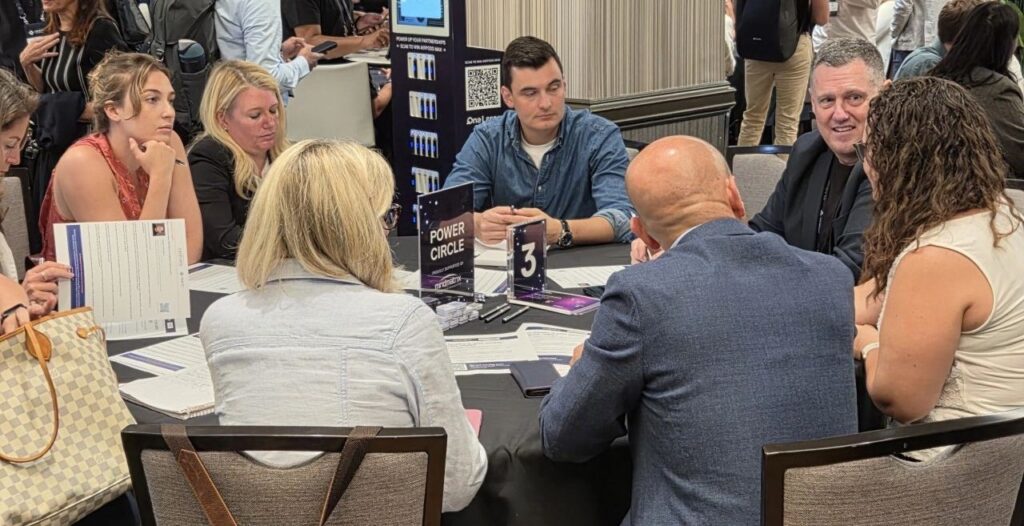
Beyond the keynotes, roundtable conversations surfaced a consistent set of themes around AI’s practical impact on partner marketing and enablement:
- AI is already improving partner marketing execution, particularly around localization and customization, which have historically been slow and resource-intensive.
- Digital PAMs are moving from concept to market reality, and one of the more interesting effects is that long-tail partners, the ones who rarely get dedicated attention from human account managers, are starting to receive meaningful support through AI.
- Partner portals came up repeatedly, and not favorably. The consensus in the room was that portals create friction and actively decrease partner engagement rather than driving it. That’s a notable data point for any partner organization still leaning on a portal-first enablement strategy.
The Challenges Nobody Fully Solved
Not every theme at Catalyst was about AI. Three challenges kept surfacing throughout the event, and they’re worth naming directly because they point to where the industry still has work to do.
Partnerships still spend energy convincing business leaders that partnerships matter. A fair amount of stage time went to reinforcing why partnerships are valuable and why the people building them are doing important work. That conversation has largely run its course for people already in the room, yet it keeps coming back. It raises a real question about who that message is actually for.
Board-level credibility remains a work in progress. A recurring concern among attendees was how to get partnerships taken seriously by the board and the rest of the organization, not just as a growth channel but as a core part of business strategy. There’s a case to be made that the cheerleading culture around partnerships actually undermines that goal rather than supporting it. Treating partnerships as a discipline that needs to prove its own case less often, and demonstrate outcomes in the typical ‘business language of the board’ more often, may be the more effective path to board-level buy-in.
AI is simultaneously the biggest opportunity and the biggest open question. Nearly every attendee is trying to figure out how to use AI to their own advantage while also determining how to support their partners through the same transition. There’s no playbook yet, which is exactly why events like Catalyst matter: they’re where that playbook starts getting written, in public, through conversations like the ones above.
Where This Leaves Partner Organizations
Catalyst 2026 made one thing clear: AI in partnerships has moved past the hype phase and into the build phase, but most organizations are still early in that build. The programs furthest along are the ones treating AI as core infrastructure for partner enablement, not a bolt-on feature. The ones further behind still have time to catch up, but the gap won’t stay open indefinitely.
Mindmatrix will be unpacking several of these themes in more depth over the coming weeks, particularly around how AI-driven partner enablement and digital PAM capabilities are reshaping partner marketing execution. For now, the team is grateful for the conversations, the connections, and the chance to hear directly from partner leaders across the industry and broader Catalyst community about where this industry is headed next.
